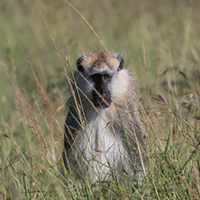
First Video of the ‘Critically Endangered’ Southern Patas Monkey
After Kruger National Park in South Africa, Serengeti National Park in northwestern Tanzania receives more tourists each year (about 500,000) than any other national park in Africa. Few of these many visitors are aware that there is a large mammal in Serengeti National Park that is seldom listed as being present, is infrequently encountered, and rarely photographed. This mammal is the Southern Patas Monkey (Erythrocebus baumstarki), a species that the IUCN Red List recognises as ‘Critically Endangered’. This monkey is profiled in Primates in Peril: The World’s 25 Most Endangered Primates 2023-2025.
The Eastern Africa Primate Diversity and Conservation Program and Grumeti Fund started a search for the ‘Critically Endangered’ Southern patas monkey in the Serengeti Ecosystem. Have you seen this monkey? Do you want to know more about this unique primate? Click here!
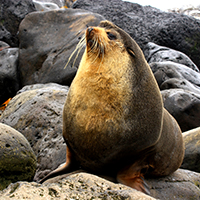
A new superfamily (Pinnipedia), family (Otariidae), genus (Arctocephalus), and species of large carnivorous mammal for Kenya; the Subantarctic fur seal Arctocephalus tropicalis
The Subantarctic fur seal Arctocephalus tropicalis (J. E. Gray, 1872) is a widespread species that occurs in sub-Antarctic waters, north of the Antarctic Polar Front/Antarctic Convergence, from the southern Atlantic Ocean and southern Indian Ocean eastwards to the southwestern Pacific Ocean. While there have been many vagrant A. tropicalis in South Africa, there is little knowledge of their occurrence on the east coast of Africa to the north of South Africa. In this paper we review what is known concerning the occurrence of A. tropicalis along the coast of East Africa (i.e., Kenya and Tanzania), and discuss two records of vagrant A. tropicalis for Kenya. This is a new superfamily (Pinnipedia), family (Otariidae), genus (Arctocephalus), and species of large carnivorous mammal for the country.
Wildsolutions.nl now hosts the results of the first systematic work to document the biological diversity represented in Uganda’s major forests, the Biodiversity Report Series (1996). These reports describe fieldwork carried out by the Uganda Forest Department during 1991-1995, aimed at listing the trees and scrubs, birds, butterflies, moths, and small mammals of the country’s 65 most important forests for the conservation of biodiversity. The purpose of this work is to provide data on the biological value of each forest and establish priorities for the designation of Nature Reserves and other conservation areas.
Uganda’s Mount Nyeri demarks both the northern limit of Otzi East Central Forest Reserve and the border with South Sudan. Photograph by Yvonne de Jong & Tom Butynski.
New paper in Primate Conservation (2024) 38: 71-81
Thomas M. Butynski and Yvonne A. de Jong
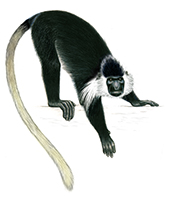
Abstract: The ‘Endangered’ Prigogine’s Angola colobus Colobus angolensis prigoginei is endemic to the Kabobo Massif along the western shore of Lake Tanganyika, eastern Democratic Republic of Congo. As the validity of C. a. prigoginei has been disputed, we compared the holotype and first photographs of a live individual against three paratypes of Cordier’s Angola colobus Colobus angolensis cordieri.