Eastern Africa Primate Diversity and Conservation Program, Nanyuki, Kenya
The River Prinia Prinia fluviatilis Chappuis, 1974, is a small passerine of the family Cisticolidae, restricted to waterside and water-logged, sometimes seasonally dry, vegetation in otherwise arid landscapes. Its distribution consists of a series of isolated wetland “islands” along the Sahelian belt, from northern Senegal in the west to northwestern Kenya (Urban et al. 1997; BirdLife International 2018; eBird 2026). The eastern-most record was obtained by Finch (2005) in 2001 near Nanam (520 m asl), 20 km southeast of Lokichokio, Turkana County, extreme northwestern Kenya. This was an eastward range extension of about 2,500 km from southwestern Chad, and the first record for Kenya and East Africa.
Northern Kenya is the most poorly known region in Eastern Africa as concerns the taxonomy, distribution, abundance, threats, and conservation status of its larger mammals. Nonetheless, this region is known to hold a high number of threatened species and subspecies. Among the larger mammals, 19 species of antelope are known to occur. During November 2025 to July 2026, we completed ‘Phase Three’ of the ‘Horn of Africa Antelope Survey’. Phase Three consisted of two field trips in northwestern Kenya covering as much of the land area as possible in the region west of Lake Turkana and Suguta Valley (i.e., west of the Eastern (Gregory) Rift Valley), north of Kainuk, east of the Uganda border, and south of the Elemi Triangle. In addition, we conducted two shorter surveys, one in far western Laikipia County (4 days) and one in the vicinity of the Merti Plateau (7 days), central Kenya. Diurnal surveys, nocturnal surveys, and camera trap surveys were conducted by two researchers (total of 47 field days; total distance driven 5,883 km).
Along the border with Ethiopia, on the Mandera Plateau, lies Kenya’s Malka Mari National Park. This national park (hereafter ‘Malka Mari’) was gazetted in 1989 and is situated southwest of the Daua (= Dawa) River in Mandera County. Rugged outcrops on both sides of the Daua River Valley are part of a limestone series known as the ‘Daua Limestone’ (Weir 1929; Ayers 1952). Erosion gullies deeply dissect the lower Daua Valley in northern and eastern Malka Mari, while part of the Awara Plains occur in southern Malka Mari. Contiguous with Malka Mari, across the Daua River in Ethiopia, lies Geraille (= Gerale) National Park (386 km²) which was gazetted in 2006.
During our second field survey of Phase 3 of the Horn of Africa Antelope Survey (April – May 2026) in Turkana County, northwest Kenya, we captured some interesting camera trap videos of a wide range of mammal species. Please find a selection (compressed) below.
We thank the Zoological Society for the Conservation of Species and Populations (ZGAP) for their financial support.
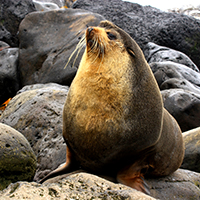
A new superfamily (Pinnipedia), family (Otariidae), genus (Arctocephalus), and species of large carnivorous mammal for Kenya; the Subantarctic fur seal Arctocephalus tropicalis
The Subantarctic fur seal Arctocephalus tropicalis (J. E. Gray, 1872) is a widespread species that occurs in sub-Antarctic waters, north of the Antarctic Polar Front/Antarctic Convergence, from the southern Atlantic Ocean and southern Indian Ocean eastwards to the southwestern Pacific Ocean. While there have been many vagrant A. tropicalis in South Africa, there is little knowledge of their occurrence on the east coast of Africa to the north of South Africa. In this paper we review what is known concerning the occurrence of A. tropicalis along the coast of East Africa (i.e., Kenya and Tanzania), and discuss two records of vagrant A. tropicalis for Kenya. This is a new superfamily (Pinnipedia), family (Otariidae), genus (Arctocephalus), and species of large carnivorous mammal for the country.