

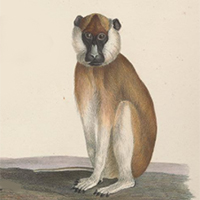
Red monkeys, red ink: Resolving pyrronotus vs. pyrrhonotus as epithets for the Patas Monkey Erythrocebus
Yvonne A. de Jong and Thomas M. Butynski
Eastern Africa Primate Diversity and Conservation Program, wildsolutions.nl
Patas monkeys Erythrocebus Trouessart, 1897 are semi-terrestrial primates endemic to tropical Africa. They are characterized by their large size (up to 18 kg), slender bodies, and red, orange, white, and black pelage (Figure 1). The taxonomy of the species and subspecies within Erythrocebus is complex and far from resolved. We are currently undertaking a review of the taxonomic arrangement within Erythrocebus.
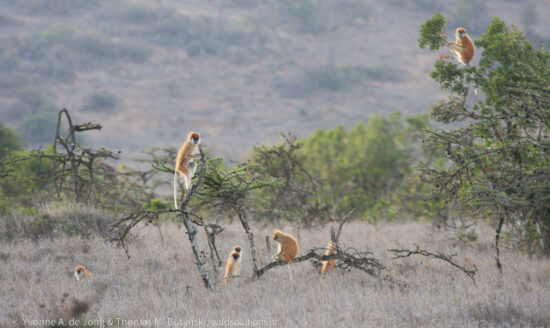
Figure 1. Eastern patas monkeys Erythrocebus patas pyrrhonotus, Borana Conservancy, Laikipia Plateau, central Kenya. Photograph by Y. de Jong & T. Butynski.
During our review of the literature, we found considerable variation in the use of the spelling of one of the epithets for the eastern patas monkey ‘pyrronotus’ vs ‘pyrrhonotus’. Also, this specific name’s authority and year of publication of these two epithets vary considerably in the literature. Table 1 presents examples of this variation.
Table 1. Variation in the spelling of ‘pyrronotus’ vs ‘pyrrhonotus’ as the epithet for the eastern patas monkey.

The confusion over ‘pyrronotus’ vs. ‘pyrrhonotus’ goes back to the protologue of Cercopithecus pyrronotus Hemprich & Ehrenberg, 1829. These authors first published the description and specific name of this monkey in Verhandlungen der Gesellschaft Naturforschender Freunde zu Berlin (1829, p. 407; Figure 2). The epithet ‘pyrronotus’ is presented twice in this work.
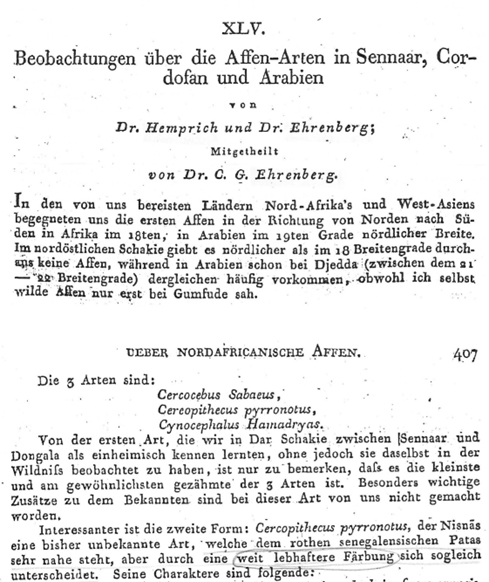
Figure 2. Title of the Cercopithecus pyrronotus prologue by Hemprich & Ehrenberg (1829) in Verhandlungen der Gesellschaft Naturforschender Freunde zu Berlin (1829) (6): 406–408.
Hemprich & Ehrenberg (1833) subsequently published additional supporting text and an illustration with a caption (Plate 10) in Symbolae Physicae (‘1832’ appears in this publication but it was not printed and made available until 1833). Here they introduced the name ‘pyrrhonotus’ (Figure 3) while the caption to the drawing applied the name ‘pyrronotus’ (Figure 4).

Figure 3. Title of the Cercopithecus pyrrhonotus protologue by Hemprich & Ehrenberg (1833) in Symbolae Physicae, seu Icons et Descriptions Mammalium (Zoologica II, Mammalium, Part I). Berlin.
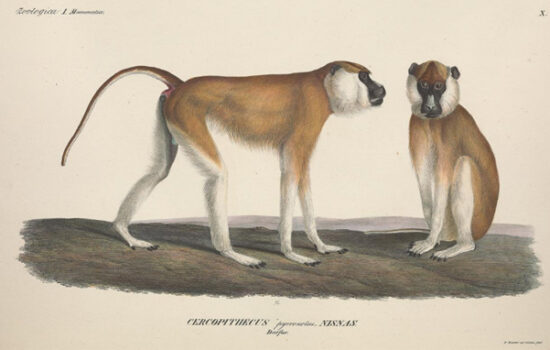
Figure 4. Cercopithecus pyrronotus in Plate 10 in Hemprich & Ehrenberg (1833). Note the spelling ‘pyrronotus’ in the caption.
Hemprich & Ehrenberg (1833) used ‘pyrrhonotus’ in the title, listed ‘pyrrhonotus’ as a synonym (i.e., Cercopithecus pyrrhonotus Ehrenberg Verhandl. d. Gesellschaft naturf. Fr. zu Berlin I. 1927), and mentioned ‘pyrrhonotus’ twice in the description, while ‘pyrronotus’ was only presented in the caption to Plate 10. It is unlikely that the spelling ‘pyrrhonotus’ is a lapsus. Note that pyrrhos originates from the Greek word pyr (fire), meaning ‘flame-colored’, ‘fiery’, or ‘red-haired’, notus means ‘back’. As such, ‘pyrrhonotus’ is morphologically consistent and semantically appropriate for Erythrocebus.
From the time of its introduction in 1829 until 1981, ‘pyrronotus’ was frequently use (Table 1), probably mostly by those who had read both Hemprich & Ehrenberg (1829) and Hemprich & Ehrenberg (1833). Geoffroy Saint-Hilaire & Cuvier (1842) used ‘pyrronotus’. Apart from Hemprich & Ehrenberg (1833), Geoffroy Saint-Hilaire (1855) appears to have been the first author to apply ‘pyrrhonotus’. Sclater (1872, 1893), Schlegel (1876), Forbes (1897), Trouessart (1897), and Anderson & de Winton (1902) followed Geoffroy Saint-Hilaire (1855) by citing ‘pyrrhonotus’.
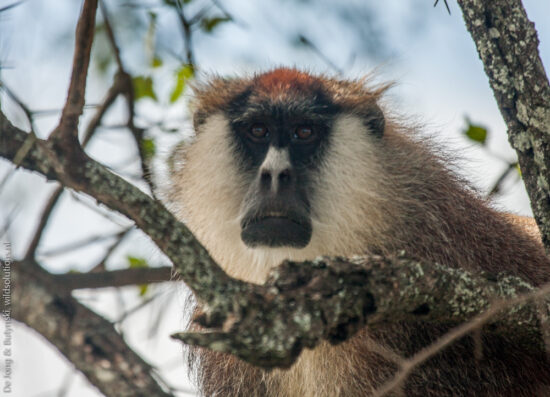
Figure 5. Adult male eastern patas monkey Erythrocebus patas pyrrhonotus, Kidepo Valley National Park, northeastern Uganda.
In 1905, Matschie brought ‘pyrronotus’ back into the literature. This usage was subsequently applied in some works (e.g., Allen 1925; Schwarz 1927; Hill 1966; Kock 1969; Yalden et al. 1977; Napier 1981), while ‘pyrrhonotus’ was retained in others (e.g., Pocock 1907; Elliot 1909, 1913; Hollister 1924; Allen 1939; Setzer 1956; Butler 1966; Dandelot 1974; Groves 1993, 2001, 2005; Grubb et al. 2003; Wallis 2013; Gippoliti 2017; De Jong et al. 2025; Table 1). The Global Biodiversity Information Facility (GBIF 2026), the IUCN Red List of Threatened Species (IUCN 2026), and the IUCN/SSC Primate Specialist Group (PSG 2026) use ‘pyrrhonotus’. The American Society of Mammalogist’s Mammal Diversity Database (MDD; 2026), however, uses ‘pyrronotus’.
The International Code of Zoological Nomenclature (ICZN, often referred to as the “Code”) is the global rulebook that ensures that every animal species has one stable, universally accepted, scientific name. Following Article 32 (‘Original Spellings’) and Article 33 (‘Subsequent Spellings’) of the Code (1999), we conclude the following (Butynski and De Jong submitted):
- That ‘pyrronotus’ Hemprich & Ehrenberg (1829) precedes ‘pyrrhonotus’ Hemprich & Ehrenberg, 1833), that ‘pyrronotus’ is the ‘correct original spelling’, and that these are the correct authority names and years of publication for these names.
- That ‘pyrrhonotus’ in Hemprich & Ehrenberg (1833) was an “unjustified emendation” and, therefore, represented an “incorrect subsequent spelling.” The reason for this is that ‘pyrronotus’ was the “correct original spelling.”
- That the “incorrect subsequent spelling” of ‘pyrrhonotus’ should now be taken as a “correct original spelling” and “current valid spelling” on the basis that ‘pyrrhonotus’ has been in “prevailing usage” for about the last 50 years.
- That ‘pyrronotus’in Hemprich & Ehrenberg (1829) is now the “historic original spelling” and “”
- That, applying the current taxonomic arrangement, the name, authority, and year of publication for the eastern patas monkey is ‘Erythrocebus patas pyrrhonotus (Hemprich & Ehrenberg, 1829).’
As far as we are aware, the correct name for the eastern patas monkey has not been of much concern—until now. The considerable disparities among the names and years used for the authority of the names ‘pyrronotus’ and ‘pyrrhonotus’ strongly suggests that few authors studied the two publications in which these names first appeared. This lack of attention to the prologues seems to be the reason that ‘pyrrhonotus’ has been able to increasingly gain usage over the past 120 years or so.
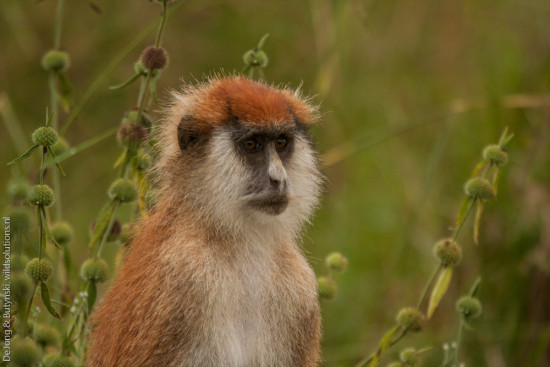
Figure 6. Adult female Eastern patas monkey Erythrocebus patas pyrrhonotus, Kidepo Valley National Park, northeastern Uganda.
References
Allen, G.M. 1939. A checklist of African mammals. Bulletin of the Museum of Comparative Zoölogy at Harvard College 83: 1–763.
Allen, J.A. 1925. Primates collected by the American Museum Congo Expedition. Bulletin of the American Museum of Natural History 47: 283–499.
Anderson, J. & de Winton, W.E. 1902. Zoology of Egypt: Mammalia. Revised and completed by W.E. de Winton. Hugh Rees Limited, London.
Butler, H. 1966. Some notes on the distribution of primates in the Sudan. Folia Primatologica 4: 416–423.
Butynski, T.M. & De Jong, Y.A. Submitted. Correct species name, authority name and year, for the Eastern Patas Monkey: First review of ‘pyrronotus’ and ‘pyrrhonotus’. African Primates.
Dandelot, P. 1974. Order Primates. Part III. In The Mammals of Africa: An Identification Manual. J. Meester & H.W. Setzer, eds. Smithsonian Institution Press, Washington, DC. Pp. 1–45.
De Jong, Y.A., Butynski, T.M. & Rylands, A.B. 2025. Erythrocebus patas. The IUCN Red List of Threatened Species 2025. Gland, Switzerland. e.T174391079A205893855. Website: <https://www.iucnredlist.org>.
Elliot, D.G. 1909. Descriptions of apparently new species and subspecies of monkeys of the genera Callicebus, Lagothrix, Papio, Pithecus, Cercopithecus, Erythrocebus, and Presbytis. Annals and Magazine of Natural History (8) 4: 244–274.
Elliot, D.G. 1913. A Review of the Primates. Volume III: Anthropoidea (Miopithecus to Pan). Monograph Series, American Museum of Natural History, New York.
Forbes, H.O. 1897. A Hand-Book to the Primates. Volume 2. W.H. Allen, London.
GBIF. 2026. Global Biodiversity Information Facility (GBIF). 2026. Website: <https://www.gbif.org/>.
Geoffroy Saint-Hilaire, I. 1855. Voyage Autour du Monde sur la Frégate la Vénus. Zoologie: Mammifères. Gide & J. Baudry, Paris.
Geoffroy Saint-Hilaire, M. & Cuvier, M.F. 1842. Histoire Naturelle des Mammifères. Muséum d’Histoire Naturelle, Paris.
Gippoliti, S. 2017. On the taxonomy of Erythrocebus with a re-evaluation of Erythrocebus poliophaeus (Reichenbach, 1862) from the Blue Nile Region of Sudan and Ethiopia. Primate Conservation (31): 53–59.
Groves, C.P. 1993. Speciation in living hominoid primates. In Species, Species Concepts and Primate Evolution. W.H. Kimbel & L.B Martin, eds. Plenum Press, New York. Pp. 325–339.
Groves C.P. 2001. Primate Taxonomy. Smithsonian Institution Press, Washington, DC.
Groves, C.P. 2005. Order Primates. In Mammal Species of the World: A Taxonomic and Geographic Reference (3rd edition). D.E. Wilson & D.M. Reeder, eds. Johns Hopkins University Press, Baltimore, MD. Pp.111–184.
Grubb, P., Butynski, T.M., Oates, J.F., Bearder, S.K., Disotell, T.R., Groves, C.P. & Struhsaker, T.T. 2003. Assessment of the diversity of African primates. International Journal of Primatology 24: 1301–1357.
Hemprich, F.G. & Ehrenberg, C.G. 1829. Beobachtungen über die Affen-Arten in Sennar, Cordofan und Arabien. Verhandlungen der Gesellschaft Naturforschender Freunde zu Berlin (1829) (6): 406–408. Website: <https://www.biodiversitylibrary.org/page/48509218>.
Hemprich, F.G. & Ehrenberg, C.G. 1833. Simia, Cercopithecus, pyrrhonotus H. et E. Symbolae Physicae, seu Icons et Descriptions Mammalium (Zoologica II, Mammalium, Part I). Berlin (‘1832’ appears in this publication but it was not published and made available until 1833). Website: <https://www.biodiversitylibrary.org/page/48509218#page/81/mode/1up>.
Hill, W.C.O. 1966. Primates: Comparative Anatomy and Taxonomy, Volume 5: Cebidae. Edinburgh University Press. Edinburgh.
Hollister, N. 1924. East African mammals in the United States National Museum. Part III. Primates, Artiodactyla, Proboscidea, and Hyracoidea. Bulletin of the United States National Museum 99: 1–164.
ICZN. 1999. International Code of Zoological Nomenclature, 4th edition. Website: < https://code.iczn.org/>.
IUCN. 2026. IUCN Red List of Threatened Species. 2026. Website: <https://www.iucnredlist.org/>.
Kock, D. 1969. Die verbreitung der primaten im Sudan. Zeitshcrift für Säugetierkunde 33: 193–216.
Matschie, P. 1905. Einige anscheinend neue meerkatzen. Sitzungsberichte der Gesellschaft Naturforschender Freunde zu Berlin 1905: 262–279.
MDD. 2026 Mammal Diversity Database. 2026. Website: <https://www.mammaldiversity.org/>.
Napier, P.H. 1981. Catalogue of Primates in the British Museum (Natural History) and Elsewhere in the British Isles. Part II: Family Cercopithecidae, Subfamily Cercopithecinae. British Museum (Natural History), London.
Pocock, R.I. 1907. A revision of monkeys of the genus Cercopithecus. Proceedings of the Zoological Society of London 77: 447–1121.
PSG. 2026. IUCN/SSC Primate Specialist Group. 2026. Website: <http://www.primate-sg.org/>.
Schlegel, H. 1876. Les singes: Simiae. Monographie 40. Muséum d’Histoire Naturelle des Pays-Bas (Leiden) 7: 1–356.
Schwarz, E. 1927. Die formen der gattung Erythrocebus. Proceedings of the Society of Naturalist Friends in Berlin. 1926: 24–31.
Sclater, P.L. 1872. Revised List of the Vertebrate Animals Now or Lately Living in the Gardens of the Zoological Society of London. Longmans, Green, Reader & Dyer, London.
Sclater, P.L. 1893. On a new African monkey of the genus Cercopithecus, with a list of known species. Proceedings of the Zoological Society of London 1893: 243–258.
Setzer, H.W. 1956. Mammals of the Anglo-Egyptian Sudan. Proceedings of the United States National Museum 106: 447–587.
Trouessart, E.-L. 1897. Catalogus Mammalium tam Viventium quam Fossilium. R. Friedlander & Sohn, Berlin.
Wallis, J. 2013. Genus Erythrocebus. In Handbook of the Mammals of the World. Volume 3. Primates. R.A. Mittermeier, A.B. Rylands & D.E. Wilson, eds. Lynx Edicions, Barcelona. Pp. 671–672.
Yalden, D.W., Largen, M.J. & Kock, D. 1977. Catalogue of the mammals of Ethiopia. 3. Insectivora and Rodentia. Monitore Zoologico Italiano, Supplement 9(1): 1–118.
Continue Reading No Comments