Thomas M. Butynski, Ian Parker and Yvonne A. de Jong
Journal of East African Natural History 104 (1&2): 41–77 (2015)
Abstract:
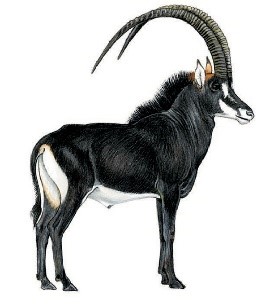
Adult male Roosevelt’s sable antelope Hippotragus niger roosevelti. Drawing by
Jonathan Kingdon (Kingdon & Hoffmann, 2013).
Roosevelt’s sable Hippotragus niger roosevelti is one of Kenya’s most distinctive and threatened large mammals. Historically, sable herds occurred in the vicinity of Taveta, and in the miombo and Diospyros woodlands of the coastal hinterland from the Roosevelt’s sable Hippotragus niger roosevelti is one of Kenya’s most distinctive and threatened large mammals. Historically, sable herds occurred in the vicinity of Taveta, and in the miombo and Diospyros woodlands of the coastal hinterland from the Tanzania-Kenya border northward for at least 210 km. Most of the historic distribution of sable in Kenya lies 15–35 km inland from the coast at 100–200 m altitude where mean annual rainfall is 800–1200 mm. In terms of numbers, however, most sable occurred in the higher and wetter Shimba Hills (150–460 m; mean annual rainfall 1000– 1200 mm). Bachelor males sometimes moved >150 km inland. Much of the decline of the distribution and size of Kenya’s sable population occurred during 1950–1980. Sable in Kenya not reported outside of Shimba Hills National Reserve after 1994. Geographic distribution of sable herds in Kenya declined from roughly 5000 km² in 1884 to 70 km² today (>98% decline in 132 years). The number of sable in Kenya was already small as of 1884, when there were probably <400 individuals. Kenya’s sable population declined from >235 individuals in the mid-1970s to ca. 60 individuals in 2015 (>74% decline in 40 years). Given the low number, small distribution, and rapid decline, sable in Kenya qualifies as a nationally ‘Critically Endangered’ species. Recommendations for the conservation of sable in Kenya are provided.
The design and implementation of effective conservation measures for primates, warthogs and hyraxes requires an efficient, low cost, and accessible resource for the identification of species and subspecies. Although photographs cannot replace an adequate museum collection as a resource for assessing species variation, geotagged photographs are a relatively fast, inexpensive, convenient, and unobtrusive means for detecting and assessing phenotypic variation within a species/subspecies over large areas. The use of photographs to document phenotypic characters will become increasingly important as the collection of specimens for hands-on assessments becomes ever more difficult.
To expand our ‘Baboon PhotoMap’ (more information on http://www.wildsolut…raphy/photomap/) we are looking for baboon photographs taken in southern Tanzania, northern Mozambique, Zambia, Malawi and southeast DRC.
If you happen to have baboon images from this region which you are willing to share, please send a copy to wildsolutions@gmail.com together with your full name (so that we can acknowledge you accordingly) and the coordinates or a detailed locality description of your record or post them in the ‘Primates of Eastern Africa’ Project on www.inaturalist.org.
Thank you very much for your help!
Adult male olive baboon (Papio anubis) lounging at the at Mount Elgon National Park at 2,150 m asl, western Kenya. Photograph by Yvonne de Jong & Tom Butynski.
By Yvonne de Jong & Tom Butynski, Eastern Africa Primate Diversity and Conservation Program
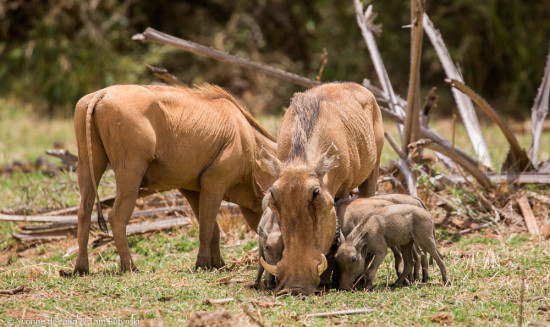
In mid-October (2015), good numbers of desert warthogs (Phacochoerus aethiopicus) were encountered on patches of short green grass near the Ewaso Nyiro River in Samburu National Reserve, central Kenya. The video below shows a solitary female (being ‘groomed’ by a red-billed oxpecker Buphaguserythrorhynchus), a bachelor sounder of six adult males, a sounder of two females with a young male and six piglets, and a female with piglets. Additional images of desert warthogs can be viewed at Warthog PhotoMap.
Desert warthog sounder at Samburu National Reserve, central Kenya. Photograph by Yvonne de Jong & Tom Butynski.
Adult male desert warthog at Samburu National Reserve, central Kenya. Photograph by Yvonne de Jong & Tom Butynski.
Young male desert warthog with two piglets at Samburu National Reserve, central Kenya. Photograph by Yvonne de Jong & Tom Butynski.
By Tom Butynski and Yvonne de Jong, Lolldaiga Hills Research Programme and Eastern Africa Primate Diversity and Conservation Program
Understanding the distribution, abundance, and habit requirements of a species is basic to establishing a baseline for its long-term monitoring at a particular site. To this end, the Lolldaiga Hills Research Programme recently produced a report titled ‘Distribution and abundance of some of the larger mammals of Lolldaiga Hills Ranch, central Kenya’. This report presents information for 42 of the 54 larger mammals that are known to occur on Lolldaiga Hills Ranch, as well as for two smaller mammals (unstriped ground squirrel and striped ground squirrel). Photographs are presented for 42 species, while distribution maps are presented for 25 species.